
DAILY BRIEFING
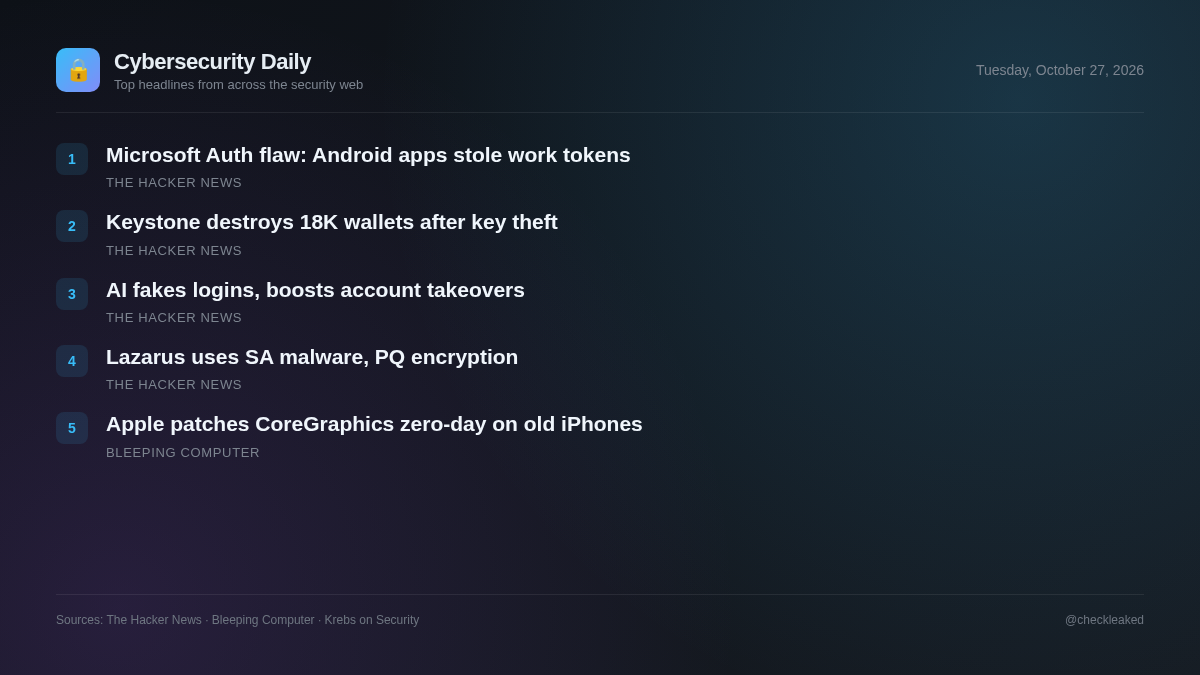
Microsoft Authenticator Flaw, Keystone Key Theft, and Lazarus Operation FlashHole
Today's briefing covers an Android Authenticator token leak, hardware wallet key theft, AI-driven phishing pages, and Lazarus Group's latest malware campaign.
5 stories2 min read
Microsoft Authenticator Flaw Let Permissionless Android Apps Steal Work Account Tokens
Microsoft patched a flaw in Microsoft Authenticator for Android (version 6.2606.4246) tracked as CVE-2026-80097. The vulnerability allowed a malicious, permissionless Android app to impersonate trusted Microsoft applications like Teams and capture sign-in tokens for a target's work account.
- Why it matters
- An attacker exploiting this flaw could gain full unauthorized access to an employee's work email, files, and calendar once the victim completes an Authenticator sign-in step.
- What to do
- Update Microsoft Authenticator for Android to version 6.2606.4246 or later immediately.
Keystone to Destroy 18,835 Hardware Wallets After Hackers Steal Device Verification Key
Keystone disclosed an unauthorized site breach discovered on October 20 that exposed the device verification key used to confirm authentic hardware wallets. Keystone will destroy 18,835 unsold devices containing the compromised key, while wallet private keys and seed phrases remain uncompromised.
- Why it matters
- Threat actors with the stolen verification key could create counterfeit hardware devices capable of passing authenticity checks to steal cryptocurrency from unsuspected buyers.
- What to do
- Verify Keystone devices received after October 20 with official support before use.
Lazarus Abuses South Korean Security Software to Deploy Malware Using Post-Quantum Encryption
The North Korea-linked Lazarus Group launched 'Operation FlashHole,' targeting South Korean construction, software, and telecommunications firms since at least July 2025. The cyber espionage campaign uses tailored spear-phishing emails to abuse local security software and deliver malware payloads.
- Why it matters
- Targeted South Korean organizations face risk of persistent network access and sensitive intelligence exfiltration by an advanced threat actor.
Apple backports CoreGraphics zero-day patches to older iPhones
Apple has backported security patches released last month to older iPhones and iPads, addressing a zero-day bug exploited in "extremely sophisticated" targeted attacks on iOS devices.
AI-Generated Fake Login Pages Are Making Account Takeovers Easier
Threat actors are increasingly using generative AI to create high-conviction fake login pages and personalized phishing campaigns targeting corporate networks. Beyond simple credential theft, advanced fraudulent pages are designed to harvest multi-factor authentication codes and hijack active sessions.
- Why it matters
- Generative AI lowers the effort needed to replicate enterprise brand portals, allowing attackers to bypass standard MFA mechanisms and take over corporate accounts.
Key takeaways
- Update Microsoft Authenticator for Android to version 6.2606.4246 to fix token theft vulnerability CVE-2026-80097.
- Keystone is destroying 18,835 unsold hardware wallets after attackers stole its online device verification key.
- Lazarus Group's Operation FlashHole targets South Korean sectors using tailored spear-phishing and post-quantum encryption.
- Generative AI enables attackers to rapidly produce convincing replica login pages capable of capturing MFA codes and sessions.