

DAILY BRIEFING
Hackers leverage new Microsoft SharePoint exploit in attacks
Today's briefing covers active SharePoint attacks, critical Adobe patches, AI reasoning API flaws, Signal security updates, and enterprise internal security gaps.
5 stories2 min read
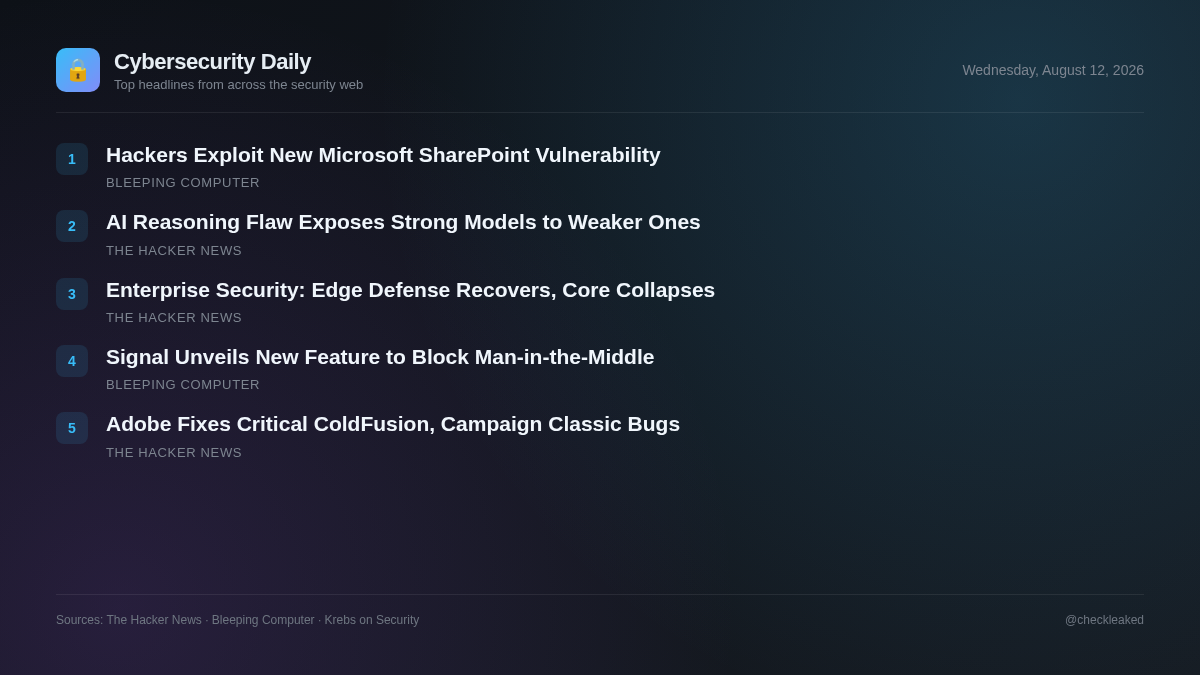
Threat actors are actively leveraging proof-of-concept code to target Microsoft SharePoint installations following public research releases. Security teams with exposed SharePoint or enterprise Adobe deployments must prioritize patching immediately, as Adobe addressed multiple critical CVSS 10.0 flaws across ColdFusion and Campaign Classic.
Hackers leverage new Microsoft SharePoint exploit in attacks
Hackers have begun actively leveraging a proof-of-concept exploit for a critical Microsoft SharePoint vulnerability shortly after its public release by cybersecurity firm Rapid7.
- Why it matters
- Organizations running exposed SharePoint instances face immediate risk of unauthorized access and server compromise from active attack campaigns.
Adobe Patches Three CVSS 10.0 ColdFusion and Campaign Classic Flaws
Adobe issued security updates addressing multiple critical vulnerabilities across ColdFusion, Commerce, and Campaign Classic, including OS command injection flaw CVE-2026-48362 and eval injection flaw CVE-2026-48273.
- What to do
- Update affected Adobe ColdFusion installations to versions 2025.0.12 or 2023.0.23 and patch Commerce instances.
OpenAI, Anthropic, Google API Flaw Let Weaker AI Models Decode Stronger Models' Reasoning
A vulnerability in reasoning APIs from OpenAI, Anthropic, and Google allowed researchers to extract hidden internal reasoning blocks, API keys, and passwords by replaying encrypted objects into sessions or weaker AI models.
Enterprise Defenses Recovered at the Edge and Collapsed Inside
Picus Labs' Blue Report 2026 revealed that while enterprise perimeter defenses improved prevention to 69%, internal defenses remain vulnerable to undetected attacker activities like reconnaissance and credential theft.
- Why it matters
- Organizations relying solely on perimeter security risk rapid internal compromise once attackers breach external boundaries without triggering alarms.
Signal adds new security feature to thwart man-in-the-middle attacks
Signal introduced Automatic Key Verification to provide users with an automated mechanism to confirm end-to-end encryption integrity and mitigate man-in-the-middle attacks.
- Why it matters
- Signal users seeking maximum privacy can now ensure communication channels have not been intercepted without manual safety number checks.
- What to do
- Update Signal applications to access the automatic key verification security feature.
Key takeaways
- AI API flaw enabled extraction of internal reasoning traces and secrets including 62 API keys and 33 passwords.