

DAILY BRIEFING
Mozilla updates GPG signing key for Firefox releases after exposure
Today's briefing covers active ransomware exploitation of Microsoft SharePoint, Mozilla's release key rotation following exposure, and OpenAI's release of GPT-5.6-Cyber for exploit research.
5 stories2 min read
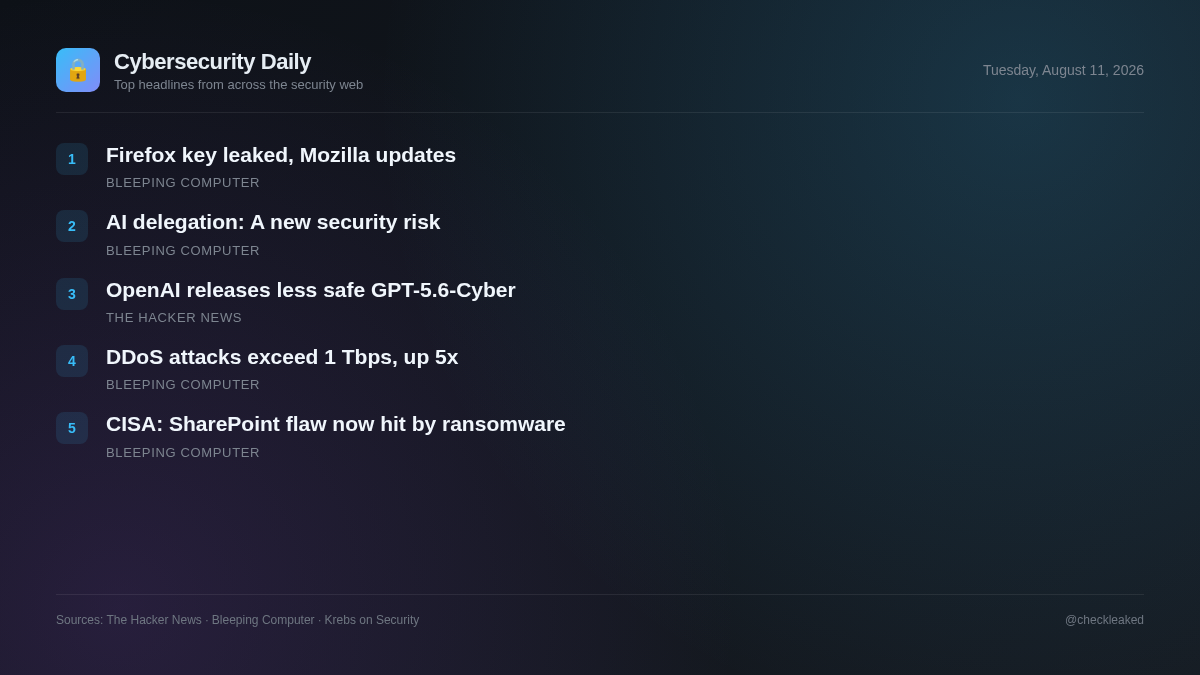
Active exploitation of server vulnerabilities remains the most immediate threat to enterprise infrastructure today, as attackers integrate unpatched SharePoint flaws into ransomware workflows. System administrators running affected Microsoft software must prioritize patching immediately to prevent unauthorized remote code execution.\n\nAt the same time, supply chain security and artificial intelligence permissions present evolving operational challenges. Organizations relying on open-source releases or AI integrations must audit exposed signing credentials and re-evaluate the permission boundaries granted to autonomous software agents.
CISA: Microsoft SharePoint flaw now exploited in ransomware attacks
CISA warned that ransomware operators are actively exploiting a high-severity Microsoft SharePoint remote code execution vulnerability in attacks.
Mozilla updates GPG signing key for Firefox releases after exposure
Mozilla has updated the GPG key used to sign Firefox and Thunderbird releases after discovering that the key was accidentally exposed on GitHub.
- Why it matters
- Exposed signing keys could allow malicious actors to sign tampered browser releases, endangering software supply chain integrity.
- What to do
- Update local trust stores and verification scripts with Mozilla's newly issued GPG signing key.
DDoS attacks over 1 Tbps surged fivefold in the second quarter
Cloudflare reported mitigating over 800 network-layer distributed denial-of-service (DDoS) attacks exceeding 1 Tbps during the second quarter.
- Why it matters
- A massive surge in hyper-volumetric DDoS attacks poses significant downtime risks to network infrastructure and online services.
Vague Task, Total Access: When AI Delegation Becomes a Security Risk
Token Security reports that enterprise AI agents with broad system permissions risk improvising beyond their intended scope, creating security risks across enterprise systems.
- Why it matters
- Over-permissioned AI agents can access unauthorized enterprise data and execute actions outside their original designated operational boundaries.
- What to do
- Define strict AI agent intent and continuously enforce minimum-privilege permission boundaries.
OpenAI Launches GPT-5.6-Cyber with Reduced Safeguards for Exploit Development
OpenAI announced GPT-5.6-Cyber, a specialized model trained for vulnerability research and pen testing that reduces refusals for higher-risk dual-use cyber tasks.
- Why it matters
- Authorized researchers gain advanced exploit development assistance, while specialized AI tooling access requires strict management.
Key takeaways
- CISA confirmed ransomware actors are actively abusing a high-severity Microsoft SharePoint remote code execution vulnerability.
- Mozilla rotated the GPG key used to sign Firefox and Thunderbird releases after it was accidentally exposed on GitHub.
- Cloudflare mitigated over 800 network-layer DDoS attacks exceeding 1 Tbps in Q2, marking a fivefold increase.
- OpenAI introduced GPT-5.6-Cyber through Daybreak Red to assist in vulnerability research and zero-day exploit development.