
DAILY BRIEFING
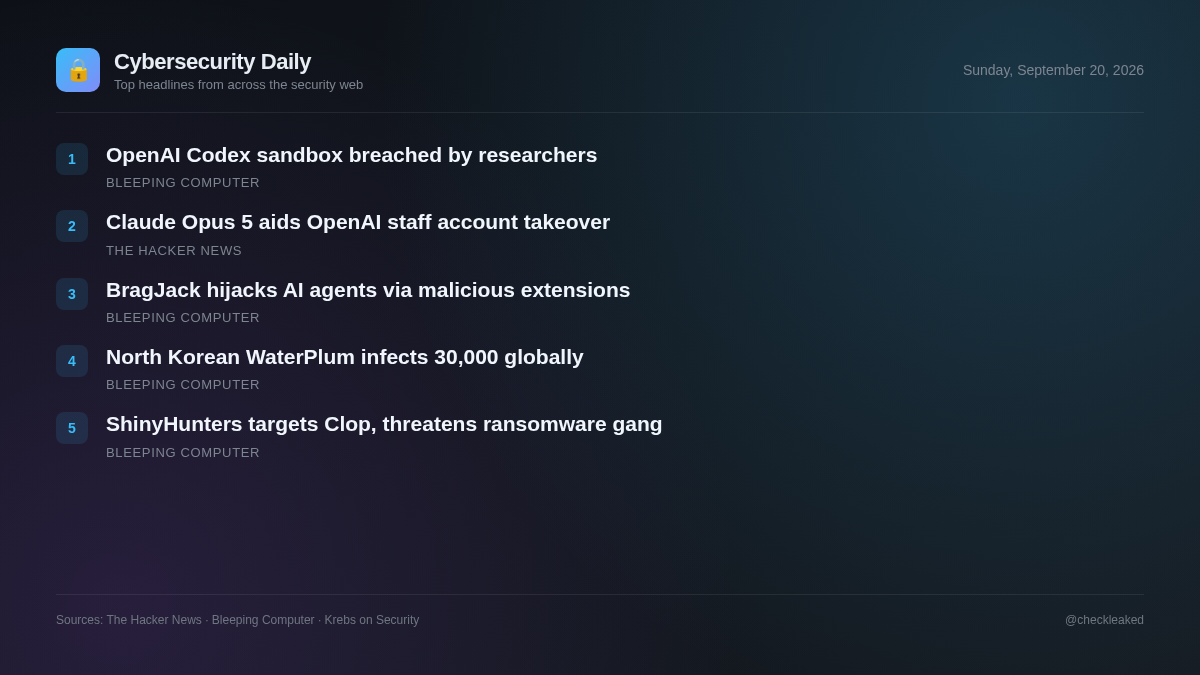
Claude Opus 5 Used to Take Over OpenAI Staff Accounts via Chained Flaws
Security researchers leveraged Claude Opus 5 to chain web and authentication vulnerabilities, gaining access to OpenAI internal accounts and code repositories.
5 stories2 min read
Researchers at security firm Hacktron demonstrated an AI-assisted attack chain using Anthropic's Claude Opus 5 to compromise internal OpenAI staff accounts and access internal code repositories.
The attack combined a vulnerability in the open-source Discourse software powering OpenAI's public help forum with a secondary flaw in OpenAI's custom authentication system. The end-to-end compromise took under 72 hours to execute.
OpenAI patched the authentication bug within 14 hours of receiving the report and awarded a $6,500 bounty to the research team on September 1. Organizations operating public community forums linked to internal identity providers should review cross-domain authentication boundaries.
Claude Opus 5 Helped Researchers Take Over OpenAI Staff Accounts via Chained Flaws
Researchers at Hacktron used Anthropic's Claude Opus 5 to chain a flaw in OpenAI's public help forum software with a weakness in OpenAI's login system. This allowed them to breach OpenAI staff ChatGPT and Codex accounts, eventually gaining unauthorized access to an internal OpenAI code repository.
- Why it matters
- Chained authentication and third-party forum bugs can compromise enterprise SSO and internal development code repositories, exposing sensitive IP and employee accounts.
Researchers escape OpenAI Codex sandbox to run commands on host
Researchers escaped OpenAI's Codex sandbox two ways, one running commands on a developer's machine from its most locked-down mode.
- Why it matters
- No technical details, vendor impact, or specific vulnerability context could be retrieved from the provided source page.
BragJack attacks hijack AI browser agents through malicious extensions
BragJack, a proof-of-concept attack from Forever Security's Gal Weizman, hijacks the AI assistants in Chrome, Edge, Opera Neon, Perplexity Comet, and Claude in Chrome using one malicious extension.
- Why it matters
- No technical details, vendor impact, or specific vulnerability context could be retrieved from the provided source page.
North Korean WaterPlum hackers infected 30,000 devices worldwide
A joint law enforcement advisory warns that the North Korean hacking group WaterPlum compromised at least 30,000 devices worldwide from December 2025 through July 2026 and transferred more than $10.7 million in stolen cryptocurrency to North Korea.
- Why it matters
- No technical details, vendor impact, or specific vulnerability context could be retrieved from the provided source page.
ShinyHunters hacks Clop leak site, threatens to extort ransomware gang
The ShinyHunters extortion gang breached the Clop (aka Cl0p) ransomware operation's data leak site, defacing the Tor site and allegedly stealing server data and the private keys for its onion service.
- Why it matters
- No technical details, vendor impact, or specific vulnerability context could be retrieved from the provided source page.
Key takeaways
- Hacktron used Claude Opus 5 to chain a Discourse forum vulnerability with an OpenAI login flaw, compromising staff ChatGPT and Codex accounts.
- The attack chain enabled access to an internal OpenAI code repository within 72 hours of initial analysis.
- OpenAI fixed the internal authentication flaw 14 hours after disclosure and awarded a $6,500 bug bounty.