

DAILY BRIEFING
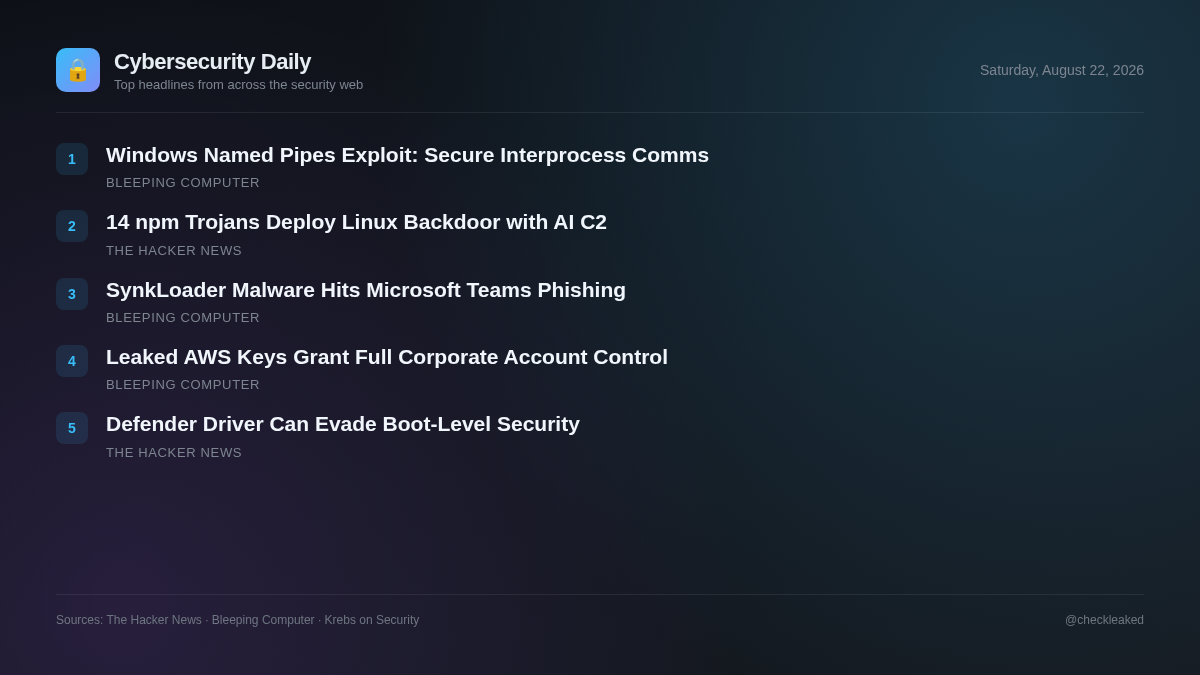
Named Pipes Under Attack: Securing Windows Interprocess Communication
Today's briefing covers boot-time driver abuse, exposed AWS credentials, supply chain attacks via npm, Microsoft Teams phishing, and Windows named pipe security.
5 stories2 min read
Cloud infrastructure teams and system administrators should act first by auditing active API credentials and restricting local driver manipulation permissions. When built-in components and developer repositories become vectors for execution, defense-in-depth and strict access controls are critical.
Hundreds of leaked AWS keys give full control over corporate accounts
More than 9,300 AWS access keys that were publicly exposed between August 2022 and August 2026 remain active, potentially allowing uncontrolled access to compromised corporate cloud accounts.
14 Trojanized npm Packages Drop RedC2 4.0 Linux Backdoor With AI-Assisted C2
Cybersecurity researchers have discovered a set of trojanized npm packages that masquerade as working calendar and streak utilities but are engineered to stealthily deliver an artificial intelligence (AI)-powered Linux implant dubbed RedC2 4.0.
New SynkLoader malware pushed in Microsoft Teams phishing campaign
A newly identified malware family named SynkLoader is being delivered via Microsoft Teams phishing campaigns. The malware steals victim credentials by displaying a fake lock screen.
- Why it matters
- Organizations utilizing Microsoft Teams are targeted by phishing attacks designed to hijack user credentials through convincing fake login screens.
Microsoft Defender's Own Driver Can Be Weaponized to Delete Security Software at Boot
Check Point Research demonstrated that Microsoft Defender's legitimate BTR.sys driver can be weaponized to execute arbitrary kernel-level file and registry modifications on Windows systems from Windows 7 to Windows 11 25H2.
Named Pipes Under Attack: Securing Windows Interprocess Communication
Windows named pipes provide fast interprocess communication, but weak access controls can expose privileged services to untrusted processes. ThreatLocker highlights endpoint verification, command authorization, input validation, and narrowly scoped privileges to secure named-pipe communication.
- Why it matters
- Organizations relying on Windows interprocess communication risk local privilege escalation if named pipes lack proper access control mechanisms.
Key takeaways
- Check Point Research demonstrated how Microsoft Defender's signed BTR.sys driver can be abused for kernel-level file operations.
- Over 9,300 exposed AWS access keys generated between August 2022 and August 2026 remain active and vulnerable to misuse.
- A new malware family named SynkLoader is targeting Microsoft Teams users via phishing to harvest credentials with fake lock screens.