
DAILY BRIEFING
Trezor Hardware Implant Discovered and Syrian Hacker Sentenced for $136B Market Drop
Today's briefing covers suspected hardware implants in Trezor wallets and the sentencing of a Syrian Electronic Army hacker.
5 stories2 min read
At the same time, legal accountability catches up with historical threat actors as a Syrian Electronic Army member receives a federal prison sentence for high-impact social media hijackings. Organizations relying on hardware security tokens and critical messaging channels must review supply vendor trust and account security controls.
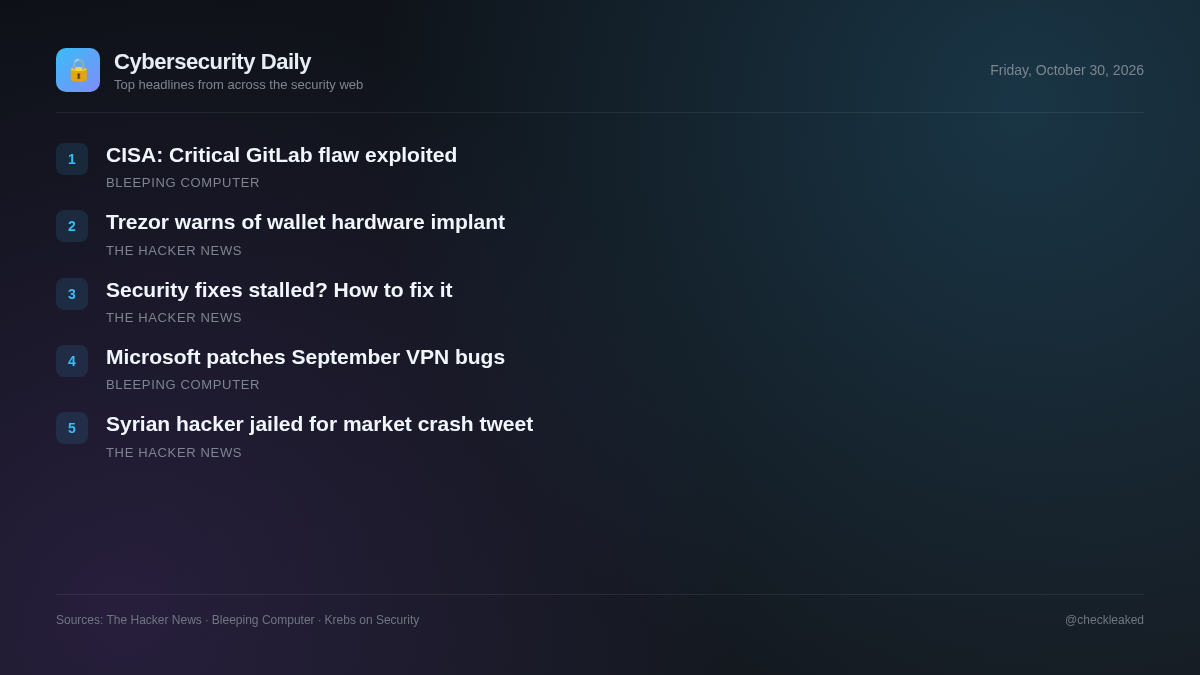
Trezor Warns of Suspected Hardware Implant in One of Its Wallets Sold by CryptoBilis
Trezor warned that a Trezor Safe 5 wallet bought from reseller CryptoBilis contains a hardware implant. The intercepted device includes an extra board with a cellular module that reads the screen and exfiltrates the wallet recovery phrase over a mobile network when plugged in.
- Why it matters
- Crypto investors who bought Trezor wallets from CryptoBilis since March 2026 face total loss of assets due to stolen backup phrases.
- What to do
- Move funds to a new wallet with a new recovery phrase if purchased from CryptoBilis since March 2026.
Why Urgent Security Fixes Aren't Fixed. Observe, Prove, Act, Confirm Gets Them Moving
Security teams often leave critical patches unapplied or IPS rules in detect mode due to operational fears of service disruption. A safe remediation approach uses evidence from testing in the live environment to prove changes will not break availability before enforcing policies.
Syrian Hacker Behind Fake Tweet That Triggered $136 Billion Market Drop Gets 42 Months in Prison
Syrian Electronic Army hacker Ahmad Umar Agha, known as Th3Pr0, was sentenced in U.S. federal court to 42 months in prison. Agha participated in a Syrian regime-backed conspiracy using phishing to hijack media accounts, including a 2013 Associated Press Twitter breach that caused a market drop.
CISA says max severity GitLab flaw now exploited in the wild
Attackers have started exploiting a maximum-severity GitLab vulnerability patched earlier this month, according to the US Cybersecurity and Infrastructure Security Agency (CISA).
Microsoft finally fixes VPN issues caused by September updates
Microsoft has resolved Always On VPN connection failures triggered after installing the September 2026 Windows 11 security updates.
Key takeaways
- Trezor advises users who bought devices from CryptoBilis since March 2026 to migrate funds to a new wallet immediately.
- A rogue circuit board in modified Trezor Safe 5 units exfiltrated recovery phrases over cellular networks.
- Syrian Electronic Army hacker Ahmad Umar Agha was sentenced to 42 months in U.S. federal prison.
- Operations testing and safe remediation evidence help resolve friction between security mandates and operational availability.